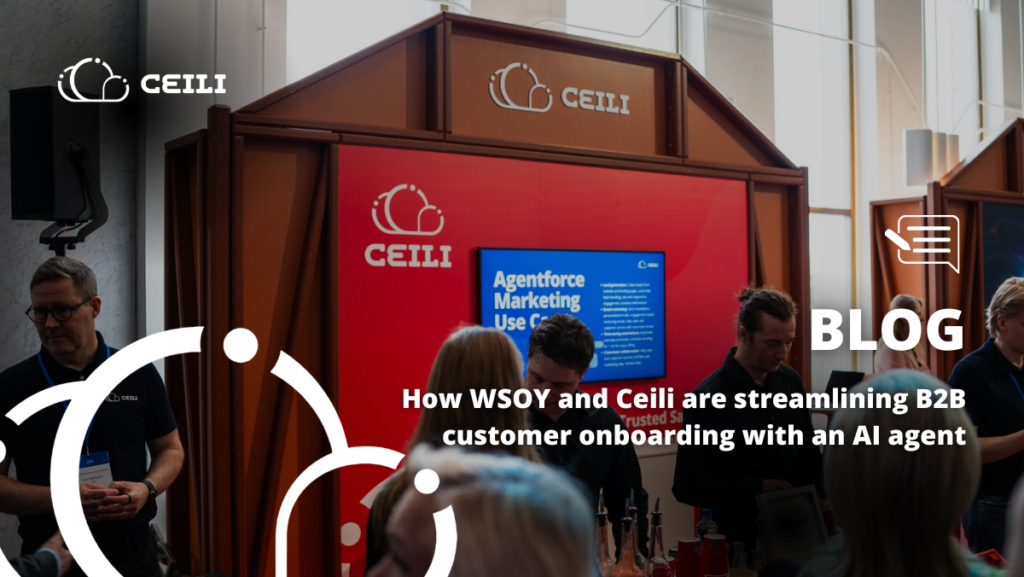
How WSOY and Ceili are streamlining B2B customer onboarding with Agentforce

2.9.2026
WSOY and Ceili are building an AI agent that streamlines how new B2B customers get onboarded. We proved the idea first on a smaller, faster-to-test workflow: an agent called Verkkokauppa Verneri that suggests relevant products for each B2B campaign, while a person still makes the final call. That same suggest-and-approve principle is now extending into the onboarding agent itself.
This article walks through where the idea started, how the campaign agent works today, and what WSOY and Ceili learned building it iteratively with agile methods.
The problem: a growing catalogue made campaign building slow and inconsistent impact
WSOY’s commercial team faced five compounding issues:
- a large product catalogue
- inconsistent recommendations between team members
- dependency on a few experts who knew the catalogue by heart
- manual shortlisting for every campaign
- and simply limited time.
Commercial teams were losing valuable selling time to manual product selection, not to a lack of technology.
From a one-day hackathon to a production agent in Agentforce
The project started at a one-day hackathon run jointly by Ceili and Salesforce. The team deliberately picked one high-impact, high-frequency workflow instead of a large, sprawling project. As Otto Heikinmäki, Senior Salesforce Developer at Ceili, put it during the case presentation: “We started by solving a practical business challenge: how to choose the right products for a campaign, quickly and consistently.”
That single-day proof of concept then moved through pilot and iteration stages before reaching production.
How the agent works, step by step
Verkkokauppa Verneri -agent follows a clear sequence.
- First, it searches available account details from the web to infer which product themes suit that customer, and stores those preferences in Salesforce to enrich the account data.
- Next, it searches an internal product index (comparable to a search engine, built on Data360) to find active products matching the account’s preferred themes. It then drafts the campaign, linking the account to it and adding the matched products.
- Finally, it drafts a follow-up email using a predefined template. A person reviews and adjusts the suggestions before anything is finalized: the agent suggests, humans decide.
Demo video: Verkkokauppa Verneri building a campaign end to end, from account selection to a completed campaign in Salesforce
The business impact
Today the agent is in production and shows measurable value in a real workflow: faster campaign preparation, more consistent recommendations across the team, and less manual work. That directly supports two business goals WSOY cared about: freeing up sales time and increasing revenue potential through better-targeted campaigns. Because campaign product selection was a high-frequency task, even a modest efficiency gain scales quickly across the whole commercial team.
The real lesson: AI quality follows context quality
The team’s clearest lesson: recommendation quality isn’t magic, it comes from context. The more relevant account history, product data, and past campaigns the agent could see, the better its suggestions became. Meaning that getting real value from AI doesn’t require a bigger model, it requires organizing the business data you already have.
Toward a full B2B customer qualification agent
Verkkokauppa Verneri was never meant to stay a standalone campaign tool. It was the first, fastest-to-prove phase of a bigger goal: a B2B Webshop Customer Qualification Agent that streamlines how new customers get onboarded. WSOY and Ceili chose campaign building as the starting point because it was high-frequency and easy to measure, which made it a good way to test whether agent-suggested, human-approved decisions would actually hold up in daily use. With that validated, the same principle, agent suggests, human decides, is now being built into the qualification and onboarding workflow itself, developed iteratively with agile methods rather than as one large upfront project.
Frequently asked questions
-
Can this approach expand to other use cases?
Yes. WSOY and Ceili are already extending the same suggest-and-approve model to customer qualification and onboarding for new B2B accounts. -
How much data do you need for this to work well?
To get started, business context data can be lightweight, as it can and should be enriched over the course of the project. However, the goal for truly high-impact recommendations is to include relevant account context, product metadata, and campaign history, not just a product catalog on its own. -
Does an AI agent like this replace people?
No. It accelerates preparation and supports decision-making, but a person still reviews and approves every recommendation before a campaign is created.
Interested in what Agentforce could do for your business? Get in touch with us, and we’ll help you find the right starting point.
Writer:
Otto Heikinmäki
Developer Team Lead &
Senior Salesforce Developer
Read more

Salesforce Flex Credits: What Are They and How Are They Used?
Salesforce licensing is changing. Alongside the traditional seat-based model, Salesforce is increasingly introducing consumption-based pricing, where costs depend more directly on what is actually done
Ceili Summer ’26 Release Notes
Intro Here is a traditional Ceili’s summary of the upcoming new features and changes in Salesforce’s Summer ’26 release. Salesforce releases an update package three

Slack – Where collaboration meets your Salesforce context
Starting its exponential growth from the Silicon Valley in the mid 2010s, Slack has since become the standard team collaboration tool used by businesses and
Salesforce®, Sales Cloud®, and others are trademarks of salesforce.com, inc., and are used here with permission.