
Tableau Next Brings Analytics and AI Agents Together
15.6.2026
Tableau Next is Salesforce and Tableau’s new analytics solution that brings AI agents and a shared semantic data layer into analytics. It helps organisations move from a question to a decision, and from a decision to action, directly where the work already happens.
Organisations have more data than ever, but using it has not automatically become easier. Decisions need to be made quickly, yet information is often scattered across systems, metrics are interpreted differently and analytics easily depends on a few individual experts. Tableau Next is designed to tackle exactly this problem.
"This is not just a new reporting tool. It is the next step towards action-driven analytics."
The data does not stay on a dashboard. It helps the user move from a question to a decision and from a decision to action.
In this article:
- What is Tableau Next?
- How does agentic analytics change the role of BI?
- Why is trusted data the foundation of AI in analytics?
- How does Tableau Next bring analytics into everyday work?
- Why does Tableau Next matter in Salesforce environments?
- What should you consider before implementing Tableau Next?
- Frequently asked questions about Tableau Next
What is Tableau Next?
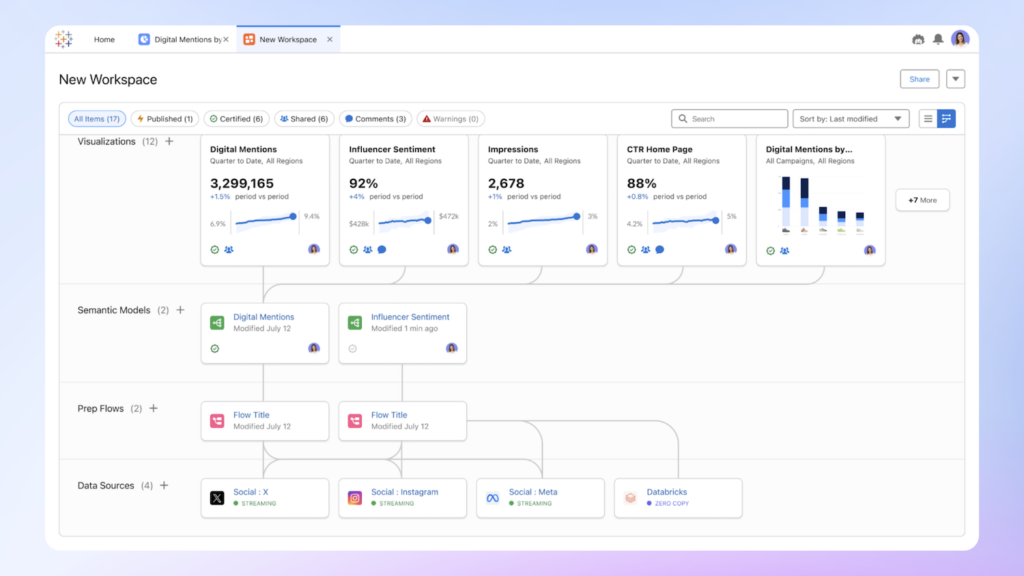
Tableau Next is Tableau’s next-generation analytics experience, built on the Salesforce platform. At its core is the idea of agentic analytics: users can work together with AI agents throughout the whole decision-making process.
In traditional business intelligence, analytics has often meant that one person builds a report, another interprets it and a third tries to turn the findings into practical action.
Tableau Next aims to shorten this journey. With it, users can:
- ask questions in natural language
- get contextual answers
- use insights suggested by AI
- trigger workflows directly from analytics
This is a significant change, especially for business users. When analytics requires less technical skill and manual preparation, data can be used more often in everyday decisions, not only in separate reporting meetings.
How does agentic analytics change the role of BI?
In Tableau Next, AI agents help speed up the entire data-to-action process. In practice, this can mean automating data preparation, creating visualisations, spotting anomalies and trends, and suggesting recommended actions.
AI capabilities related to Tableau Next:
- Data Pro: helps with preparing and transforming data. Its purpose is to lighten the traditionally laborious work of building data layers and defining relationships between data.
- Concierge: lets users ask their data questions in natural language and get answers without building an analysis from scratch.
- Inspector: monitors data proactively and highlights relevant changes, trends or anomalies.
Their value lies in the fact that analytics is no longer just passive viewing of dashboards. It becomes a more active partner that helps users notice what matters and move forward faster.
Why is trusted data the foundation of AI in analytics?
AI in analytics is only useful if the data it relies on is trustworthy and correctly interpreted. That is why a key part of Tableau Next is Tableau Semantics, a semantic layer that defines business concepts, metrics, relationships and calculations consistently.
From a business point of view, the impact is very practical. When terms such as “customer”, “revenue”, “active opportunity” or “profitability” mean the same thing to every team, analytics becomes more comparable and decisions more consistent.
The semantic layer also helps AI agents give more accurate, context-aware answers. Without a shared understanding of the data, AI can still produce answers, but relying on them in business remains uncertain. In Tableau Next, trusted data, governed semantics and AI belong together.
How does Tableau Next bring analytics into everyday work?
One of Tableau Next’s most interesting promises is bringing analytics into the tools people use every day. Tableau Next can be used in Slack, for example, where teams can share metrics, view dashboards and ask their data questions as part of their conversations.
This matters because decisions are rarely made inside a BI tool. They are made in the daily discussions of sales, customer service, marketing, management and operational teams. When analytics is closer to these situations, data does not remain a separate report but becomes part of the workflow.
Tableau Next’s built-in actions take analytics one step further: an insight can lead directly to an action, such as follow-up processing, an alert, a task or another business process.
"This is a big difference compared to analytics that ends with the user spotting a problem on a dashboard and having to figure out the next steps alone."
Why does Tableau Next matter in Salesforce environments?
Tableau Next is built on the Salesforce platform and uses the Data 360 data layer, Hyperforce infrastructure and Agentforce. This makes it especially interesting for Salesforce customers, because analytics, customer data, AI agents and workflows can be connected more closely than before.
In practice, this could mean that:
- Sales users get analytics-based recommendations on the best opportunities
- Customer service spots changes in customer satisfaction in time
- Management gets faster visibility into the key drivers of the business
- Teams can see the discussions around each other’s metrics, which reduces silos within the organisation
Tableau Next does not mean that existing Tableau investments lose their value. Tableau Next is part of a broader analytics portfolio that also includes Tableau Cloud, Tableau Server and CRM Analytics.
What should you consider before implementing Tableau Next?
The greatest value of Tableau Next does not come from the technology alone. It comes from knowing which decision-making bottlenecks you want to solve with analytics and AI agents.
Before implementation, consider at least these three things:
- Data foundation: Are your key metrics, concepts and data sources consistent enough? Agentic analytics highlights the importance of a good data model, because the AI’s answers are built on it.
- Use cases: Where is the gap between analytics and action biggest today? A good starting point might be sales prioritisation, spotting anomalies in customer service, tracking marketing results or predictive reporting for management.
- Users’ everyday work: Where do people make decisions and which tools do they use every day? If analytics can be brought closer to these situations, its impact grows.
The most important question is not just “What does Tableau Next do?” but rather “In which decisions would better, faster and more action-driven analytics create the most value for us?” Once you have the answer, Tableau Next can be a significant step towards a more data- and AI-driven way of working.
Frequently asked questions about Tableau Next
What is Tableau Next?
Tableau Next is Tableau’s next-generation analytics experience built on the Salesforce platform. It combines analytics with AI agents and a shared semantic layer, so users can move from questions to decisions and actions faster.
What is agentic analytics?
Agentic analytics means that users work together with AI agents throughout the decision-making process. The agents can help prepare data, create visualisations, spot trends and anomalies, and suggest recommended actions.
What is Tableau Semantics?
Tableau Semantics is the semantic layer in Tableau Next. It defines business concepts, metrics, relationships and calculations consistently, so that teams and AI agents interpret data in the same way.
Does Tableau Next replace Tableau Cloud or Tableau Server?
No. Tableau Next is part of a broader analytics portfolio that also includes Tableau Cloud, Tableau Server and CRM Analytics, so existing Tableau investments keep their value.
Where could Tableau Next help your business most?
Shall we explore together which stages of your business processes would benefit most from Tableau Next? Get in touch at info@ceili.fi

Writer:
Emmi Minkkinen
Salesforce Consultant
Salesforce®, Sales Cloud®, and others are trademarks of salesforce.com, inc., used here with permission.
